
Art Reading Scripture
- trinitymilaca
- Aug 1, 2025
- 4 min read
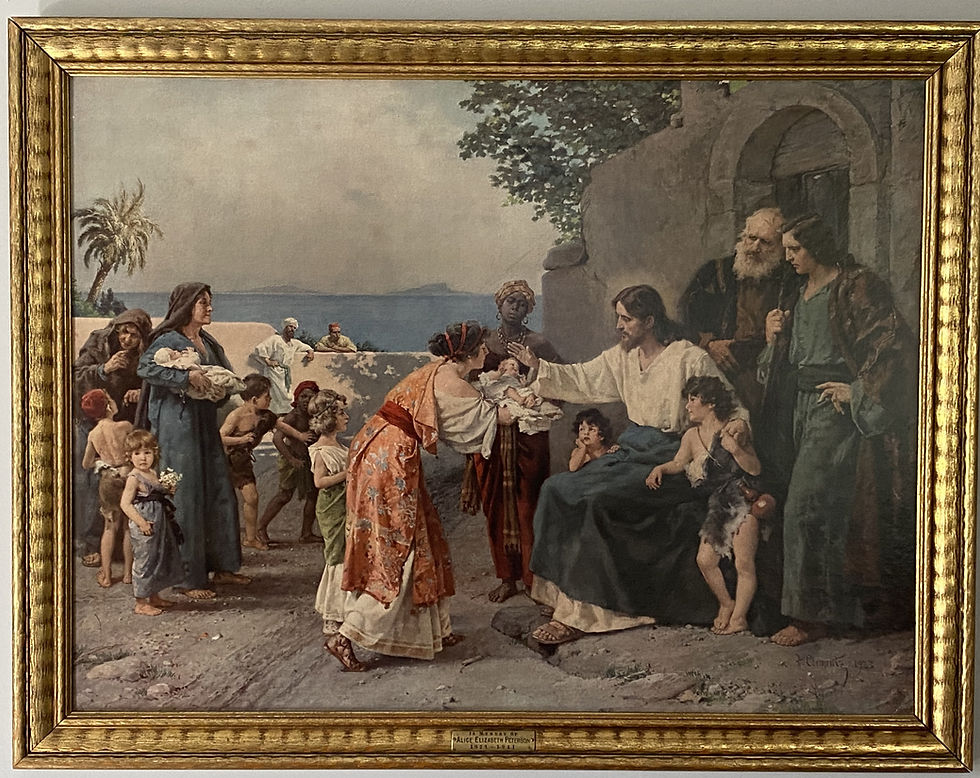
Let the little children come to me; do not stop them, for it is to such as these that the kingdom of God belongs. Mark 10:14
Art reflects cultural assumptions that were normal at one time and problematic today. This painting hangs in many Church meeting rooms. It's themes of childhood, baptism and blessing express gentleness, acceptance and comfort. Nine children fill the scene, along with nine adults. Few paintings include such a gathering of children. Jesus welcoming and blessing children is associated with baptism. Indeed, the argument for infant baptism finds support from this scene. The two children specifically being brought to Jesus, (as opposed to those who simply are there or are playing in the background,) are dressed in baptismal gowns.
"People were bringing children to Jesus in order that he might touch them, and the disciples spoke sternly to them. But when Jesus saw this he was indignant and said to them, 'Let the children come to me; ..." We think of children as innocent, cute, and precious. The innocence and purity of children aligns with the state of redemption gained in receiving the kingdom of God. One might think that innocence and purity are what make children so acceptable to God. The disciples and others in the age of Jesus did not have the same attitude or feelings about children. Children were valued for their potential roles. Children were socially inferior along with slaves and just below women. A child was burdensome, not viewed as fully a person until they approached or achieved usefulness. Childhood was short with the goal of becoming something useful. Children were without rights, seen as property, and could even be sold by their parents. Echoes of those ideas still exist. In some traditions infant baptism is rejected because a child has not reached an age of accountability. In others words, until the child's actions count, they don't fully count. People used to say, "Children should be seen and not heard." Parents needed to control busy, noisy children in church. There were no children's sermons and running down the aisle was forbidden. Jesus welcomed children on the basis of the unwelcome they received from the world. Jesus welcomed the ones for which the world has no use. It was not because they were cute and innocent, but rather because the represented the least and the last of society who had no value in themselves. Rather than welcoming the pure and the innocent, Jesus welcome of children was a welcome to who were seen as next to nothing. In 1923 the presence of so many children in a painting with Jesus may have been surprising and upsetting. The cute little girl in the front makes eye contact with viewer to say, "Do you see me?" Another child is being hushed, probably being told to behave. In the back another boy, white, is blocking a black child from approaching Jesus. That raises an issue, assumption from 1923 that may have been shocking to consider then and is problematic to view now.
All the characters in the painting are Caucasian, white, except two. A small black boy is being blocked by another boy, preventing him from approaching Jesus. The black woman in the scene is clearly in a servant role. No one looks at her and she does not have a child to present to Jesus for a blessing. By the expression on her face she knows that she does not belong and that she would not be received or blessed. I do wonder what kind of statement H. Clements might have been making. Did he want the viewers to consider the Black woman and boy distanced from Jesus? Are we to look into the woman's eye as she gazes out at us, "Do you see me?" Did Clements present them as socially inferior to the pure white women as children were once seen as socially inferior, akin to slaves, from a world of the past? Racial attitudes in 1923 remained rooted in centuries of slavery no where near approaching the age of Civil Rights and equality. Was the woman, like the boy, sternly spoken to not approach Jesus? Was Jesus there for the pure and the innocent? I have been uncomfortable having this painting still hung in the church. I see in it an attitude from a past I do not embrace. On the other hand it makes me think about those who are vulnerable, seen as worth less, who are ignored or pushed off to the side, or who serve the privileged? It reminds me that my place in the scene has always been among the acceptable and welcomed, the privileged and the blessed. I was received into grace and God in baptism. I have come to know that all are welcome, not as a mere assumption, but as a reminder that still, not all are welcomed, received and blessed by the world in which we live.
Keep the faith. Say your prayers. Love like Jesus
Pastor Tim Bauer


Comments